
Headlines:
PH, Dutch NGO ink 5-year deal to rid Pasig River of plastic wastes
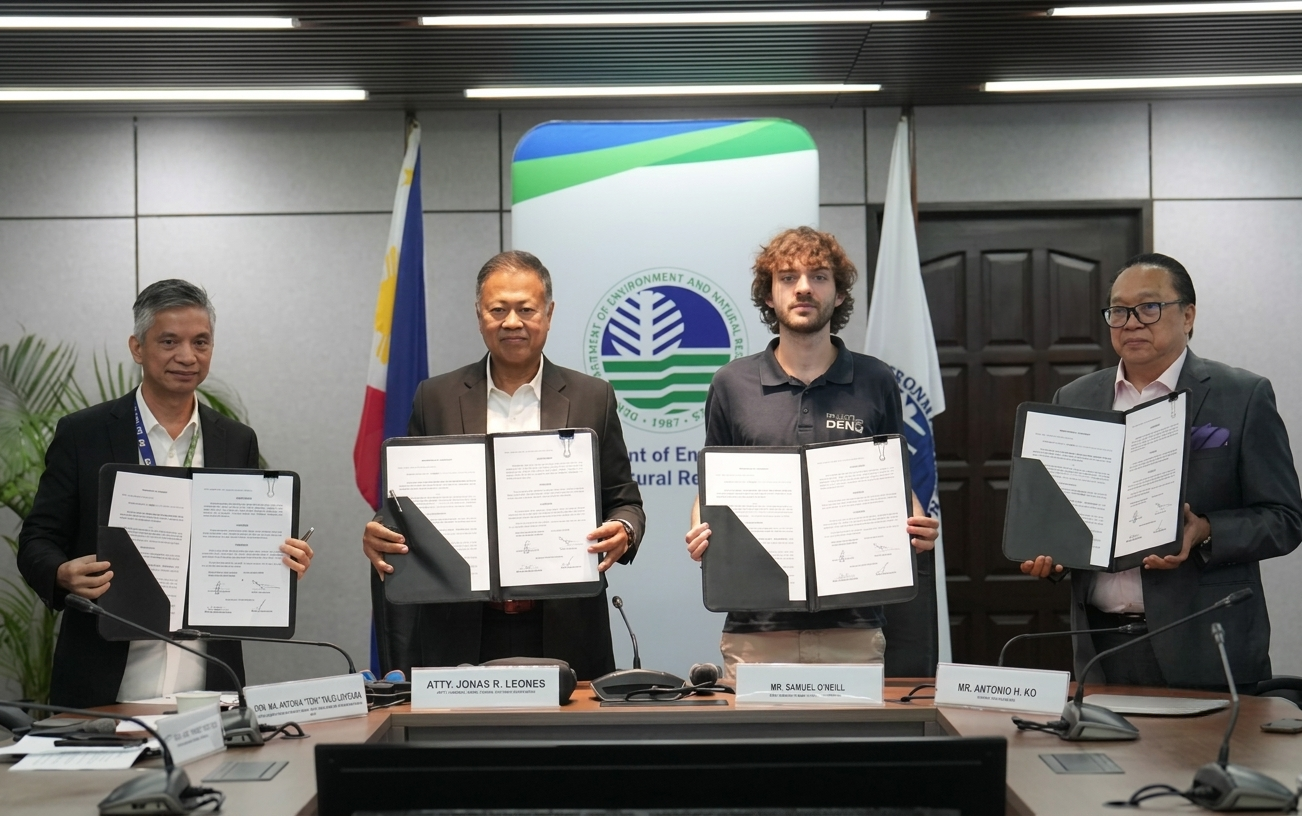
Photo c/o Philippine News Agency
The Ocean Cleanup’s work in Manila is being supported by Energies PH which views the collaboration with The Ocean Cleanup as part of a larger initiative: to help build sustainable communities by connecting clean energy, clean water, resilient infrastructure, and practical environmental stewardship.
The Interceptor is a technology, but the real project is larger. It is about restoring confidence that even our most difficult environmental problems can be addressed when science, government, enterprise, and community work together,” said Antonio Ver, chairman and chief executive of Energies PH.
Read more here: PH, Dutch NGO
Pivot to BIMP-EAGA-ANZ for sources of synergy in AI and energy
By Antonio A. Ver
In the past, the market reserved a special place for the best product and another for the cheapest product. But lately, the calculus dictates that products’ physical visibility takes center stage. One can buy only what can overcome the challenges that lie between farms and markets.
In this light, the pivot to the Brunei Darussalam–Indonesia–Malaysia–Philippines East ASEAN Growth Area (BIMP-EAGA) – Australia New Zealand (ANZ) Corridor makes sense. Shorter travel time matters more than longer travel time when it comes to the physical movement of goods.
Now more than ever, there is a need to look beyond face value and focus on synergy — creating a whole that is much greater than the sum of its parts.
Artificial Intelligence
The strategic value of the Australian region highlights the National Electricity Market (NEM), Tasmania’s renewable energy stability, and the potential for specialized high-performance computing (HPC) projects, including those under development in Queensland.
This frames the connection between BIMP-EAGA and ANZ as a diversified Asia-Pacific strategy for latency-tolerant AI workloads, while recognizing the infrastructure and governance requirements needed for success.
For two decades, the dominant metaphor for digital infrastructure has been the “cloud” — a weightless, placeless abstraction. That metaphor is changing. Artificial Intelligence, particularly large-scale model training, consumes electricity at scales comparable to industrial manufacturing.
A single hyperscale data center can draw 100–200 megawatts (MW) continuously, while future clusters are projected to reach gigawatt scale by 2030.
Traditional hubs such as Singapore face grid saturation and infrastructure constraints, forcing a reassessment of geography.
This raises the question of whether the BIMP-EAGA region, together with Australia and New Zealand, can form a viable Asia-Pacific computing corridor. While these locations offer strong advantages, success depends on addressing infrastructure gaps and governance challenges.
The key variables include:
- Capital and operating costs
- Electricity pricing and cooling requirements
- Power system reliability and dispatchability
- Network connectivity, latency, and redundancy
- Data sovereignty and regulatory stability
Energy: Beyond Baseload to Dispatchability
BIMP-EAGA has substantial resources, including Sarawak’s 3,500 MW hydropower capacity and Mindanao’s geothermal resources. However, its power grids remain fragmented. The challenge is ensuring 99.99% availability for hyperscale loads without dedicated generation.
Australia’s National Electricity Market (NEM) provides approximately 65 GW of installed capacity. Although transmission congestion exists, its mature electricity market allows sophisticated price management.
Tasmania, with a high share of renewable generation, provides a stable, low-carbon alternative.
New Zealand offers an approximately 85% renewable grid, and its infrastructure policies support potential data center development through improved permitting processes.
Critical Minerals and Digital Connectivity
The physical infrastructure of AI depends on critical minerals such as copper, nickel, and rare earth elements.
Indonesia and the Philippines hold significant nickel resources, while Australia has established rare earth processing capabilities.
Locating computing infrastructure closer to these supply chains can reduce logistics risks, especially for integrated facilities involving processing and component assembly.
For connectivity, AI model training is generally latency-tolerant. BIMP-EAGA’s 35–70 millisecond latency to Singapore and Tokyo may be acceptable for training workloads.
However, AI inference applications requiring less than 50 milliseconds will continue to favor locations closer to major population centers, such as Johor and Batam.
Australia’s east coast serves Oceania effectively but faces higher latency to Southeast Asia.
Governance, Carbon Exposure, and Workload Segmentation
BIMP-EAGA operates through “developmental regionalism,” coordinating infrastructure across different national systems.
Australia and New Zealand provide stronger regulatory stability but also face challenges, including complex federal and regional governance structures.
Companies increasingly require access to 100% renewable energy, favoring locations such as:
- Sarawak’s hydropower resources
- Tasmania’s renewable energy systems
- New Zealand’s geothermal generation
Carbon-intensive grids may require additional renewable energy arrangements to meet corporate sustainability requirements.
The corridor is most competitive for AI training clusters, which prioritize affordable power and land availability over ultra-low latency.
AI inference workloads, however, will remain concentrated near population centers.
Three Scenarios for 2035
Scenario A: Strong Policy Coordination
Effective regional cooperation attracts 500–1,000 MW of AI training capacity to EAGA.
Scenario B: Incremental Growth
Investment remains concentrated in existing hubs, with EAGA attracting 100–300 MW through selected projects.
Scenario C: Carbon-Driven Shift
Corporate sustainability requirements push demand toward high-renewable locations such as Tasmania and New Zealand.
Conclusion: Conditional Promise
The BIMP-EAGA and ANZ regions offer genuine potential for a diversified Asia-Pacific computing strategy.
The “cloud” is becoming a physical infrastructure challenge, and its future depends on transforming constraints into competitive advantages.
Success will depend not only on resource availability, but also on effective grid integration, infrastructure development, and regulatory coordination.
Antonio A. Ver is Chairman, President, and CEO of Energies PH; Chairman of Energies Global Data; and Chairman of Energies Global Endowment “Ideas for the World.” He previously served as Program Director for BOT Projects at the Department of Transportation and Communications (1989–1995), overseeing telecommunications, aviation, ports, maritime, coast guard, rail, and urban transport systems. He was an independent director of the Philippine Electricity Market Corp. (2009–2015), founder and chairman of the Asia Pacific Basin for Energy Strategies, and founder-trustee of the Energy Service Company Association of the Philippines.
Read more here: https://bworldonline.com/opinion/2026/03/27/738952/pivot-to-bimp-eaga-anz-for-sources-of-synergy-in-ai-and-energy/
